Language and connection · AI-created illustration
October 8, 2026
Your Child Mixes Two Languages. Should You Be Worried?
That mixed-language sentence deserves a second look
“Can I have the bleu one?”
Bleu is French for blue. Your child has used two languages to ask for one thing.
Your child says it without hesitation. You pause. Should I ask them to say the whole thing in one language? Are they getting confused?
Before you correct that sentence, consider this: borrowing a word from another language is common in bilingual development. The more surprising question is what children might learn from being around people who speak differently.
That everyday moment opens up a less familiar side of language learning: noticing what the person listening understands. A study of young children offers an interesting clue.
Two languages in one sentence: should you worry?
Using words from two languages in the same sentence is often called code mixing. It is a common part of bilingual development. A child might borrow a word because they do not yet know it in the other language, cannot recall it quickly, or hear adults around them speaking that way.
A research review by language-development researchers Krista Byers-Heinlein and Casey Lew-Williams explains that mixing languages does not, by itself, mean a child is confused. Think of two growing toolboxes: your child reaches for a useful word to help you understand.
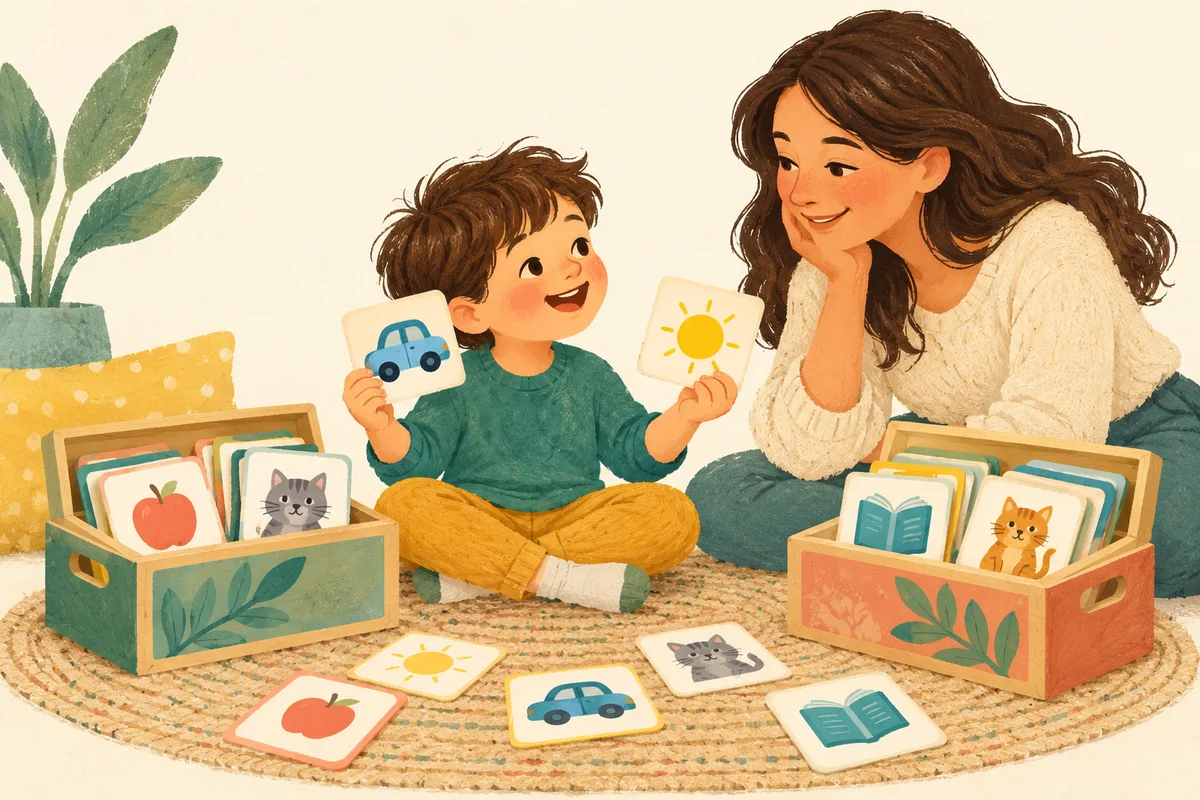
Two growing vocabularies. One message to share. AI-created conceptual illustration.
Read the research review: Bilingualism in the Early Years
This can happen with English and French, English and Chinese, or other language combinations. The important question is what your child is trying to tell you.
More than new words: who understands what?
Different people understand different languages. A child might hear French with one relative and English with another. These exchanges offer chances to notice which words make sense to which person.
Considering the listener also involves noticing what they know or can see. That connection is what the next experiment explored.
The hidden question: “What can you see?”
In a 2015 University of Chicago study, 72 children aged 4–6 played a communication game: 24 in each of three language groups. Some objects were hidden from the adult but visible to the child. To understand a request, children had to account for the adult’s view.
Imagine three toy cars. The smallest is hidden from the adult. When the adult asks for the small car they can see, choosing the correct one means setting aside your own view.
Average accuracy across four critical trials
Study sample: 72 children, 24 per group. Percentages are average task accuracy, not the proportion of children with a particular ability. Bars show reported rounded means; uncertainty intervals are not shown.
See the original study: results and Figure 2, page 4
The takeaway: learning to consider the listener
Both groups with experience of another language did better on this task. The exposure group mainly spoke English. Fluent bilingualism was not required for the pattern seen in this study.
The researchers suggested that multilingual environments may give children practice noticing differences between people: Who understands this language? Which words will make sense to them? What information do they have?
The finding has limits. This small study compared children with different language backgrounds. It did not test whether language lessons caused the difference. It points to a possible connection between everyday language experiences and taking a listener’s perspective, rather than showing that bilingual children are always more empathetic.
When they mix languages, what can you do?
Start with what your child means. Then gently model the word in the language you are using.
Your child: “Can I have the bleu one?”
You: “The blue one? Of course! Let’s find it.”
You have understood the request and offered the English word without interrupting the exchange for a test. If you are speaking French together, you can model the French phrase instead.
One mixed sentence does not need to become a lesson. Leave room for your child to keep talking, asking and being understood.
Three small ways to make language meaningful
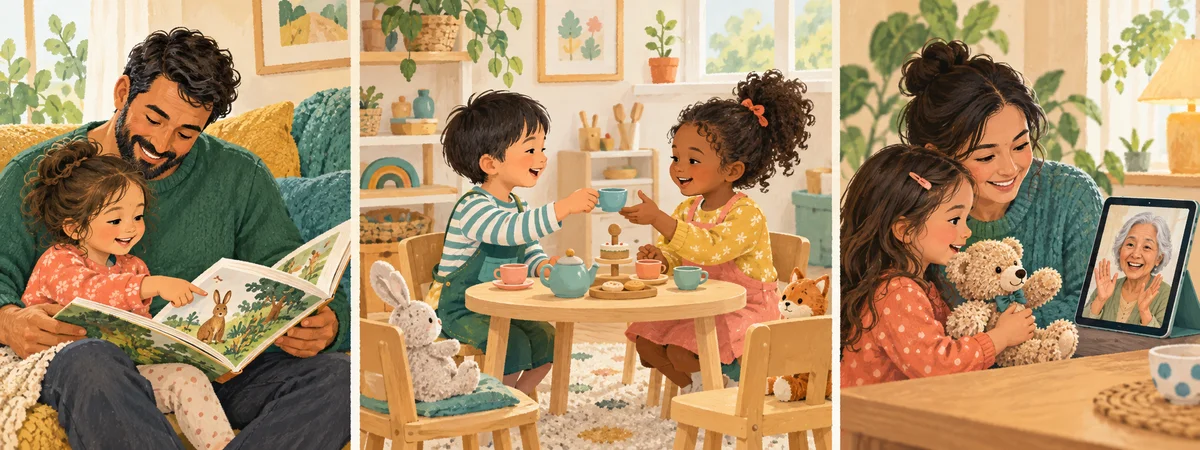
A book, a pretend café, a familiar face: everyday reasons to start talking. AI-created illustration.
1. Let a story start a conversation
Read a picture book in a language you are comfortable using. Pause to talk about a character’s expression or ask what might happen next. Leave room for pointing, short answers and questions; it does not need to become a vocabulary quiz.
2. Play with a purpose
Set up a pretend café, toy shop or animal clinic. Take turns asking for something and responding. A useful phrase becomes part of the game because someone needs it to keep the play going.
3. Make room for real connections
Invite your child to show a favourite toy to a relative who speaks another language, or share a familiar song together. If a word is missing, gestures and help from an adult can keep the exchange going.
These are ideas for creating conversation, rather than a formula for producing a particular developmental outcome. Follow your child’s interest and keep the experience comfortable.
Find a language class that fits your family →
Choosing a class: look beyond the language name
If you are considering a studio or language school, ask a few practical questions before joining:
- Who is the class for? Check the ages and whether it welcomes beginners, heritage-language learners or children with previous experience.
- How is the language used? Ask how much time children spend listening, speaking and interacting, and whether songs, stories or games are part of the lesson.
- How are new learners supported? Find out how the teacher helps children who need time before they feel ready to speak.
- Will it fit everyday life? Consider the location, schedule, fees and opportunities to keep using the language between lessons.
A second-language class, a heritage-language program and a bilingual class may offer different experiences. Check each program’s description and ask the studio about its teaching approach.
Ready for more bonjour moments?
Perhaps your goal is a chat with grandparents, a first conversation in French, or simply a welcoming introduction to another language. Start with that connection, and choose a learning environment that suits your child.
Meet the two Calgary studios featured in our carousel. Both introduce languages through play, with different languages and programs to explore.
Polyglots: French and Spanish
Polyglots offers play-based immersion with music, art and games. Its programs give children opportunities to hear and use French or Spanish while taking part in activities.
Visit Polyglots’ official website
A French Start: French
A French Start introduces French through songs, stories, movement and interactive play. It offers parent-and-child and independent programs, so families can explore the format that suits their child.
Explore A French Start’s official class information
More words. More people to connect with.
Explore language-learning studios on LekkerKids and check each studio’s current ages, schedules and class details.
Share this post
Stay Updated
Get Weekly Events & Site Updates
Calgary family picks, new features, and promotions — straight to your inbox.
More for your family in Calgary